
Welcome to IT4Innovations & Blender
Exploring high-performance computing and advanced rendering technologies.
High-Performance Rendering on Supercomputing Infrastructure
High-performance computing (HPC) is extensively used in computer graphics, particularly for image synthesis and the rendering of complex virtual scenes. Such rendering workflows have broad practical applications, including mechanical engineering, industrial and product design, and the entertainment industry.
To significantly accelerate rendering workloads, supercomputing resources can be employed to parallelize and scale the computation beyond the capabilities of local hardware.
Rendering-as-a-service
We provide a Python add-on for Blender, BRaaS-HPC, which converts a standard user-defined rendering task into a dedicated high-performance computing (HPC) job. The add-on functions as an SSH-based remote client, enabling transparent offloading of rendering workloads to supercomputing infrastructures.
The BRaaS-HPC add-on is available at: https://github.com/It4innovations/braas-hpc
Interactive Rendering and Computation on HPC Systems
We also provide BRaaS-HPC-Interactive, a Python add-on for Blender that enables interactive rendering and computational workflows on HPC clusters. Building on the core BRaaS-HPC functionality, this extension supports real-time interactive sessions with HPC resources, allowing users to execute custom commands and scripts directly on compute nodes while continuing to work within the Blender environment.
The BRaaS-HPC-Interactive add-on is available at: https://github.com/It4innovations/braas-hpc-interactive
Open-Source Rendering Tools
- CyclesPhi – extended Blender Cycles renderer for supercomputers: multi-GPU data distribution for massive scenes, remote and stereo/VR rendering.
- BRaaS-HPC RenderEngine – library and Blender add-on that display images rendered remotely on the cluster in the Blender viewport.
- CyclesPhi ANARI device – exposes the Cycles / CyclesPhi path tracer as a Khronos ANARI device for scientific visualization applications.
- SpaceConverter – MPI/GPU converter of astrophysical simulation output to OpenVDB/NanoVDB for volume rendering in Cycles, with the BSPACE Blender add-on.
Usage & User Projects
Chora by Gaia Radić
(2025)
Dejvický kampus by Michal Faltýnek
(2025)
Spring by Blender Studio
(2019)
Agent 327: Operation Barbershop by Blender Studio
(2017)
Scientific Visualization
Astrophysical Simulations with SpaceConverter
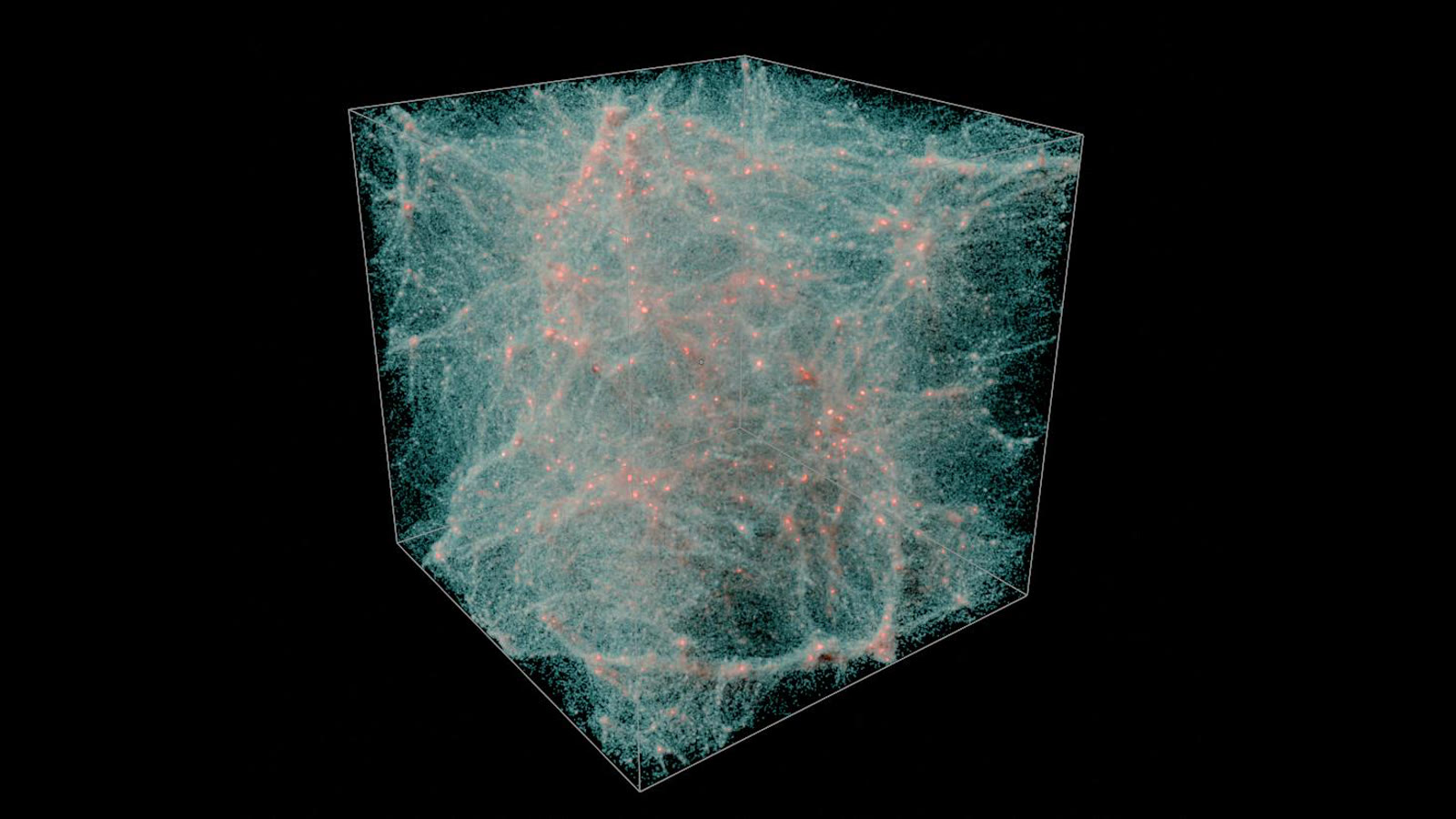
Within the EuroHPC SPACE Centre of Excellence we develop SpaceConverter, a parallel CPU/GPU tool that converts particle and grid output of astrophysical and plasma physics codes into OpenVDB/NanoVDB volumes for high-quality volume rendering in Blender Cycles and CyclesPhi. The animations below show data from OpenGadget3, ChaNGa, iPIC3D, BHAC, gPLUTO, GRACE and RAMSES.
Videos: Zenodo record 10.5281/zenodo.23394314 | Source code: github.com/It4innovations/space-converter | Publication: VisGap 2026
OpenGadget3 – Cosmic Web
Gas filaments and halos of a cosmological simulation.
(2026)
OpenGadget3 – Massive Black Hole Orbits
Orbits of massive black holes in a dark matter halo.
(2026)
ChaNGa – Spiral Galaxy
Volume rendering of a simulated spiral galaxy.
(2026)
ChaNGa – Large-Scale Structure
Flight through the cosmic web of a cosmological simulation.
(2026)
ChaNGa – Cosmological Volume
The whole simulation box rendered as a volume.
(2026)
iPIC3D – Plasma Turbulence
Structures of a particle-in-cell plasma simulation.
(2026)
iPIC3D – Plasma Simulation
Particle-in-cell plasma data visualized as volumes.
(2026)
BHAC – Black Hole Jets
Accretion onto a black hole with relativistic jets.
(2026)
BHAC – Accretion Flow
Black hole accretion flow and jet.
(2026)
gPLUTO – Astrophysical Flow
Magnetohydrodynamic simulation rendered as a volume.
(2026)
gPLUTO – Spherical Flow
Magnetohydrodynamic simulation rendered as a volume.
(2026)
GRACE – Simulation Slices
Cross-sections of a general-relativistic simulation.
(2026)
GRACE – Accretion Disk
Accretion disk and outflow of a general-relativistic simulation.
(2026)
GRACE – Relativistic Matter
Volume rendering of a general-relativistic simulation.
(2026)
RAMSES – Interacting Galaxies
Galaxies with tidal tails from an adaptive-mesh simulation.
(2026)
RAMSES – Turbulent Medium
Turbulent gas from an adaptive-mesh simulation.
(2026)
Engineering, Medical and Other Visualizations
Electric Motor
Volume rendering of velocity field in Blender Cycles
(2024)
Ball
Volume rendering of vortex Q-criterion in Blender Cycles
(2024)
Electric Motor - Interactive
Interactive remote volume rendering in Blender Cycles
(2024)
Train Simulator
Physically based rendering of virtual training scenes for machine learning in Blender Cycles.
(2022)
CT Volume Rendering
Computed tomography data were converted to OpenVDB and rendered using Blender Cycles.
(2022)
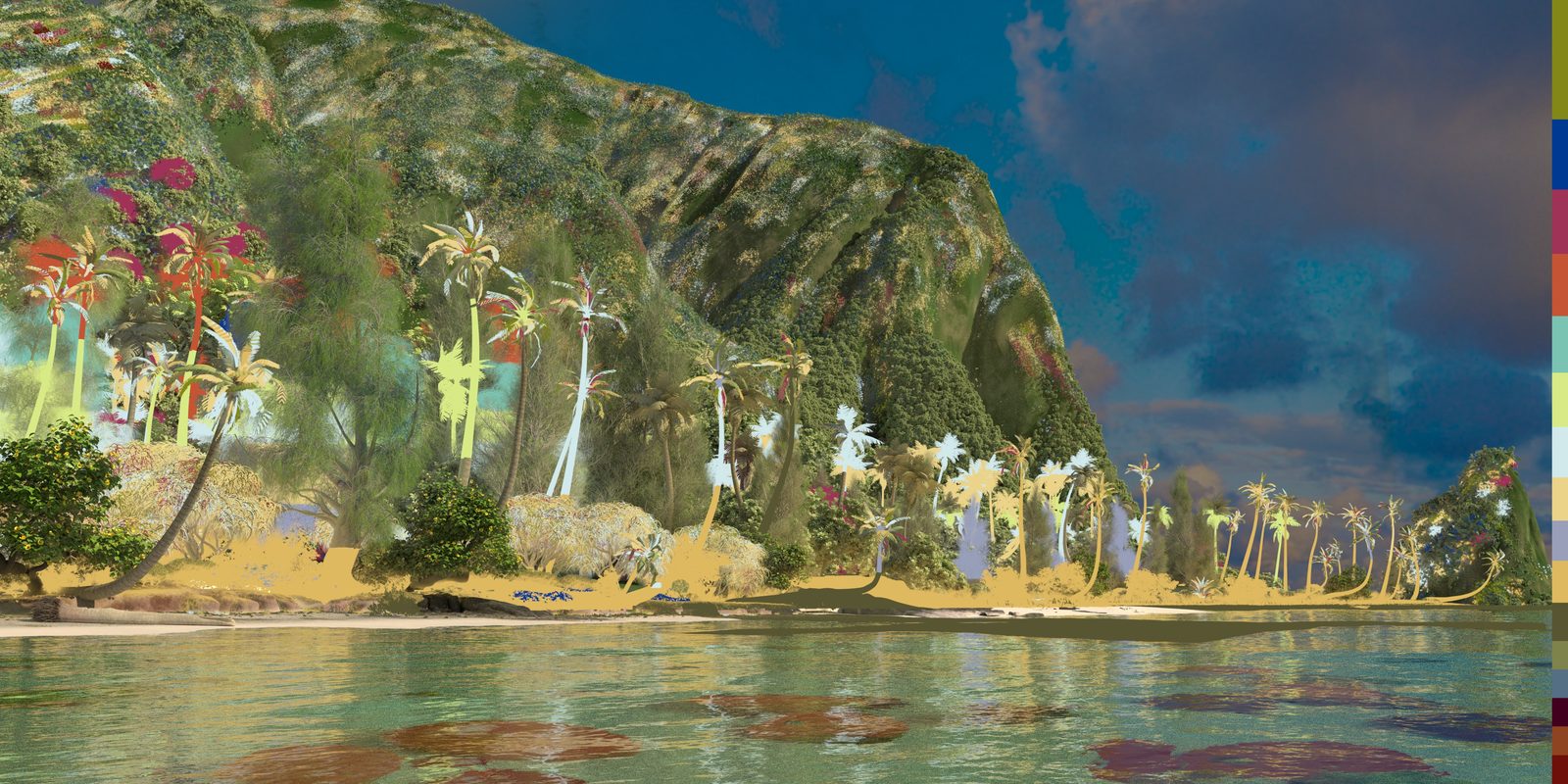
Moana Scene
Demonstration of GPU-accelerated rendering for massive production scenes in Blender Cycles.
(2022)
Research
We research rendering in Blender and its path tracer Cycles on supercomputers: how to render scenes that do not fit into a single GPU, how to turn huge simulation data into film-quality images, and how Blender can work with renderers beyond Cycles.
Blender + ANARI
NewANARI (Analytic Rendering Interface) is the Khronos standard API for rendering in scientific visualization: one application can drive many different renderers through a single interface. We research how Blender can render through any ANARI renderer while users keep working with ordinary Blender scenes, materials and render settings.
ANARI is connected to Blender as a device of Cycles. Blender syncs the scene into Cycles as usual, and the device translates it into ANARI objects: meshes, curves and hair, point clouds, volumes, instances, lights, cameras and the world. Viewport and final renders, render passes and denoising keep working inside Blender, and the renderer is selected in the render properties like any other device.
What we investigate
- Materials. How Cycles shader node graphs map to other renderers: flattened into one physically based material, with procedural parts baked by the Cycles kernel, or sent as a complete graph to renderers that evaluate graphs themselves (Cycles XML, MaterialX, MoonRay RDL).
- Volumes. OpenVDB and NanoVDB volumes exported as structured fields and rendered with principled volumes or transfer functions.
- Consistency with Cycles. Automated tests render the same scenes with Cycles and with each ANARI renderer and compare brightness and block-wise differences, from small test scenes up to the Cycles demo files.
- Conformance to the specification. Differences in lights, materials and volumes are traced to the renderer or to the ANARI specification and fixed in the renderer devices.
- Portability. The whole stack is built and tested on Windows, on Linux (headless nodes with NVIDIA RTX PRO 6000 Blackwell GPUs) and on macOS with Apple silicon.
Renderers tested directly in Blender
| Renderer | Hardware |
|---|---|
| Cycles as an ANARI device | CPU, CUDA, OptiX, Metal |
| Barney (data-parallel path tracer) | CUDA / OptiX |
| VisRTX | OptiX |
| Intel OSPRay | CPU |
| AMD Radeon ProRender | GPU (CUDA, HIP), CPU |
| DreamWorks MoonRay | CPU, XPU |
| Mitsuba 3 | CUDA, CPU, Metal |
| Visionaray | CPU, CUDA |
| Photon (Kokkos path tracer) | CUDA with OptiX, CPU with Embree |
| Helide (ANARI SDK reference) | CPU |
Scenes can also be written to USD through ANARI-USD.
Barbershop rendered in Blender through ANARI with Barney (Full HD, 4096 samples), and the Cycles demo scenes Classroom, Barcelona Pavilion and a character scene rendered with Cycles and eight ANARI renderers (64 samples, no denoising).
GPU Path Tracing of Massive Scenes
Production scenes such as Disney's Moana Island do not fit into the memory of a single GPU. We extended Cycles to distribute scene data across all GPUs of a node instead of replicating it. The distribution is based on an analysis of memory accesses, so adding GPUs increases both the speed and the maximum scene size. Out-of-core support stores data that does not fit on the GPUs in CPU memory.
Volume Rendering of Large Simulation Data
Simulations produce terabytes of results on unstructured meshes or as particles. We develop HPC workflows that load the data in parallel, resample it to OpenVDB/NanoVDB volumes and render it with physically based volume path tracing in Cycles, from billion-cell CFD simulations to astrophysical simulations converted with SpaceConverter. Multi-resolution grids guided by fractal dimension reduce the volumes to a few percent of their size while keeping fine detail.
Cycles on HPC Architectures
Our first work on Cycles accelerated it on Intel Xeon Phi and many-core CPUs with AVX-512 vectorization, distributed rendering over MPI on clusters, interactive rendering for virtual reality on HPC, BM3D denoising of rendered images and the energy efficiency of rendering.

Fractal dimension-guided multi-resolution grids for high-quality visualization of astrophysical data
(2026) Astronomy and Computing
Visualizing the Cosmos: Bridging Astrophysical Simulations with Volume Rendering
(2026) Eurographics Workshop on Visualization Gaps (VisGap)
Out-of-core aware multi-GPU rendering for large-scale scene visualization
(2026) Future Generation Computer Systems
Workflow for high-quality visualisation of large-scale CFD simulations by volume rendering
(2025) Advances in Engineering Software
Multi-GPU Accelerated Rendering of Massive Scenes with Out-of-Core Support for CPU Memory
(2025) Lecture Notes in Computer Science, PPAM2024
High Performance Visualization for Astrophysics and Cosmology
(2025) Proceedings - 33rd Euromicro International Conference on Parallel, Distributed, and Network-Based Processing, PDP 2025
Speed Up of Volumetric Non-Local Transform-Domain Filter Utilising HPC Architecture
(2023) Journal of Imaging
Interactive Rendering with Blender Cycles for Virtual Reality using High Performance Computing Clusters
(2019) AIP Conference Proceedings
Energy consumption evaluation of Blender's image renderer in HPC environment
(2019) Proceedings of the Sixth International Conference on Parallel, Distributed, GPU and Cloud Computing for Engineering, Civil-Comp Press
Implementation of BM3D Filter on Intel Xeon Phi for Rendering in Blender Cycles
(2018) Lecture Notes in Computer Science
Rendering in Blender Cycles using MPI and Intel® Xeon Phi™
(2017) ACM International Conference Proceeding Series
Acceleration of Blender Cycles path-tracing engine using Intel® many integrated core architecture
(2015) Lecture Notes in Computer Science
Direct Volume Rendering from Multi-level Compressed Data
(2026) PPAM 2026
Presented by M. Faltýnková
Bridging Cosmological Simulations and High-Quality Visualizations using HPC resources
(2025) 9th Users' Conference of IT4Innovations
Presented by P. Strakos
Cinematic Visualization of A&C Simulation Data with Blender
(2025) SPACE CoE High-Performance Computing Visualization workshop
Presented by P. Strakos and M. Jaros
Blender as a tool to generate synthetic datasets for training AI models
(2024) BKON – CZ/SK Blender Conference 2024
Presented by P. Svobodova
Jak dostat slona do mixeru
(2023) CZSK Blender Conference
Presented by M. Jaros
GPU-accelerated distributed rendering of massive scenes in Cycles
(2022) Blender Conference 2022 in Amsterdam
Presented by M. Jaros
Rendering on an HPC cluster with RAAS
(2019) 3rd Users Conference of IT4Innovations 2019 in Ostrava
Presented by P. Strakos
Cycles: High Performance Blending
(2019) Blender Conference 2019 in Amsterdam
Presented by L. Riha
Scientific data visualization using Blender & COVISE
(2019) Blender Conference 2019 in Amsterdam
Presented by P. Strakos
Blender in HPC Environment
(2018) Blender Conference 2018 in Amsterdam
Presented by L. Riha
Rendering in Blender Cycles using AVX-512 Vectorization
(2018) IXPUG Europe Spring 2018 in Bologna
Presented by M. Jaros and P. Strakos
Rendering in Blender Cycles Using Intel® Xeon Phi™ (Code Named Knights Landing)
(2017) Intel® HPC Developer Conference 2017 in Denver
Presented by L. Riha
Selected Intel® Xeon Phi™ Accelerated Libraries developed at IT4Innovations
(2017) 6th Annual Conference of IT4Innovations and 1st Users Conference of IT4Innovations 2017 in Ostrava
Presented by L. Riha and M. Merta and M. Jaros
Acceleration of Blender Cycles Render Engine using Intel® Xeon Phi™
(2017) IXPUG/EMEA 2017 at University of Cambridge
Presented by M. Merta
The Fundamentals: How to accelerate Blender with the Intel® Xeon Phi™ coprocessors
(2016) IXPUG/EMEA 2016 in Ostrava
Presented by M. Jaros
Visualisation of Massive Black Hole Orbital Decay in Dark Matter Halos
(2026) HPCSE 2026
Presented by M. Jaros
Multi-Resolution Grid Reconstruction for Efficient Volume Rendering of Large-Scale Simulation Data
(2026) HPCSE 2026
Presented by M. Faltýnková
Scalable Volume Rendering of Billion-Cell CFD Simulations Using VFX Pipelines
(2025) Proceedings - SIGGRAPH 2025
Presented by P. Strakos
Volume-based cinematic visualization from OpenGADGET
(2024) HPCSE 2024
Presented by M. Jaros
Toward Scalable Voxelization of Meshes with High Growth Rate
(2022) SC22 in Dallas
Presented by M. Hrabánková
Blender based Rendering-as-a-Service Platform for High Performance Computing Clusters
(2018) High-Performance Graphics 2018 in Vancouver
Presented by M. Jaros
Energy Consumption Optimization of Rendering in Blender Cycles on x86 Architectures
(2018) High-Performance Graphics 2018 in Vancouver
Presented by L. Riha
Interactive and Offline Rendering in Blender Cycles Using MPI and Intel® Xeon Phi™ Offload
(2016) SC16 in Salt Lake City
Presented by L. Riha
Projects
InnovAIte Slovakia: Illuminating Pathways for AI‑Driven Breakthroughs
Generating data from virtual environments in Blender
(2025-2027)
AI4NanoForce: AI analysis of atomic force microscopy data
Synthetic AFM images generated in Blender for training segmentation and classification models
(2025-2027)
Khronos ANARI data-parallel rendering
Collaboration with NVIDIA and the University of Cologne on data-parallel rendering with the ANARI standard, including an ANARI device for Cycles
(2024-...)
REFRESH: Research Excellence For REgion Sustainability and High-tech Industries
Visualization of a laboratory for hydrogen production research
(2024-...)
SPACE: Scalable Parallel Astrophysical Codes for Exascale
Processing and visualization of A&C data in Blender
(2023-2026)
EuroCC 2: Realistic architectural visualizations using HPC resources
Proof of concept with industry: high-quality architectural rendering in Blender on HPC and presentation in VR
(2023-2025)
TACR: Railway simulator for obsacle detection project
Generating data from virtual environments in Blender
(2020-2022)
About Us

Lubomír Říha
Head of Infrastructure Research Lab
lubomir.riha@vsb.cz
Specialist in HPC cluster computation.

Petr Strakoš
Senior Researcher
petr.strakos@vsb.cz
Focused on scientific visualization, ML and rendering services.

Milan Jaroš
Researcher
milan.jaros@vsb.cz
Expert in GPU acceleration and path-tracing for massive scenes.